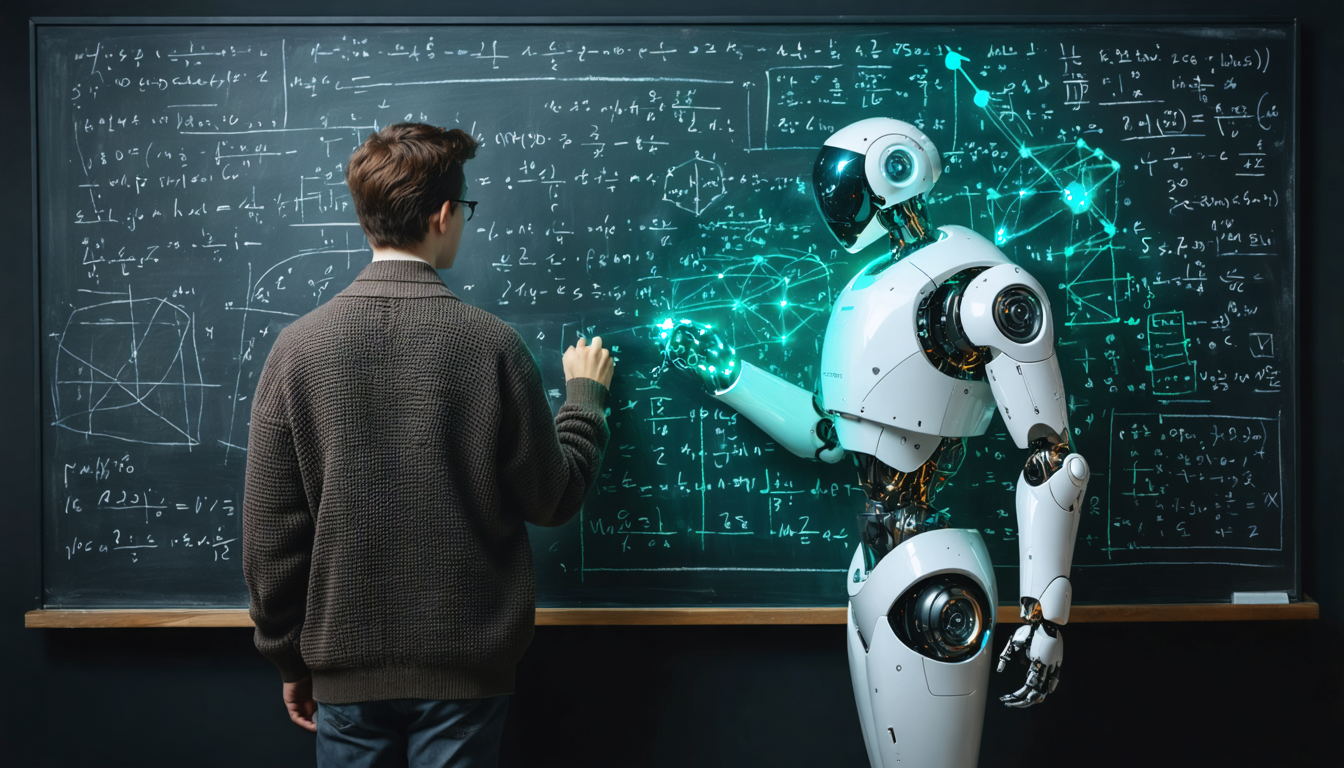
In July 2025, AI achieved gold-medal-level scores at the International Mathematical Olympiad (IMO). Both OpenAI and Google DeepMind scored 35 out of 42 — matching human gold medalists. In 2024, AI had only reached silver. It took just one year to reach gold.
That same year, AI surpassed the median score of human gold medalists on the theoretical portion of the International Physics Olympiad (IPhO), though experimental problems were excluded.
So where do the human medalists go? Now that AI has caught up in raw problem-solving ability, where are these brilliant minds, and what are they doing?
This article examines the career paths of medalists from the major International Science Olympiads, based on publicly available research, papers, and reporting.
This is not an original tracking study. The main data sources are listed below, each with its own scope and limitations.
| Source | Type | Scope | Sample | Limitations |
|---|---|---|---|---|
| xquant Substack (Neeloy Banerjee, 2024) | Personal blog (data analysis) | IMO gold medalists | 700+ | Gold medalists only. Silver/bronze excluded. Based on LinkedIn and public info — some individuals may be missing |
| Yuret et al. (Scientometrics, 2024) | Peer-reviewed paper | IMO medalists (gold/silver/bronze) | Undisclosed (broad) | Finds Google as top employer, but trends differ from xquant when limited to gold medalists |
| Medium article (chierhu, 2025) | Personal blog (case studies) | IOI medalists | Individual cases | Not systematic statistics — focuses on notable individuals |
| ACS (American Chemical Society) | Industry media | IChO participants | Individual cases | US participants only. Not a statistical analysis |
For all Olympiads except IMO, systematic career tracking data is virtually nonexistent. Descriptions of IPhO, IChO, and IBO medalist careers are based on individual cases and general inferences. Read with that in mind.
The International Science Olympiad Landscape
All 12 Disciplines
“International Science Olympiads” is not a single organization. Each discipline has its own independent governing body and runs its own competition. “ISOs” is simply a collective term. Wikipedia currently lists 12 recognized competitions.
The ISOs primarily target secondary school students (middle and high school). Age limits vary by discipline, and middle schoolers can and do compete — some win gold at 13 or 14.
| # | Abbr. | Discipline | Since |
|---|---|---|---|
| 1 | IMO | Mathematics | 1959 |
| 2 | IPhO | Physics | 1967 |
| 3 | IChO | Chemistry | 1968 |
| 4 | IOI | Informatics | 1989 |
| 5 | IBO | Biology | 1990 |
| 6 | IPO | Philosophy | 1993 |
| 7 | IAO | Astronomy | 1996 |
| 8 | iGeo | Geography | 1996 |
| 9 | IOL | Linguistics | 2003 |
| 10 | IJSO | Junior Science | 2004 |
| 11 | IESO | Earth Science | 2007 |
| 12 | IOAA | Astronomy & Astrophysics | 2007 |
New disciplines continue to emerge — IOAI (Artificial Intelligence) was established in 2024.
Source: Wikipedia - International Science Olympiad (updated Feb 2026)
Scope of This Article: The Major 5
Tracking medalist careers across all 12 disciplines is impractical — data simply doesn’t exist for most. This article focuses on the five largest and longest-running disciplines.
| Olympiad | Discipline | Since | Countries | Team Size | Medal Criteria |
|---|---|---|---|---|---|
| IMO (Math) | Mathematics | 1959 | ~110 | Up to 6 | Top ~50% medal (G:S:B ≈ 1:2:3) |
| IPhO (Physics) | Physics | 1967 | ~90 | Up to 5 | Top ~50% medal |
| IChO (Chemistry) | Chemistry | 1968 | ~85 | Up to 4 | Top ~66% medal (G12%/S22%/B32%) |
| IOI (Informatics) | Computer Science | 1989 | ~90 | Up to 4 | Top ~50% medal |
| IBO (Biology) | Biology | 1990 | ~80 | Up to 4 | Top ~50% medal |
IMO (Math) Medalists — The Most Tracked
IMO gold medalist careers are the best documented, thanks to Neeloy Banerjee’s tracking of 700+ individuals (xquant Substack, 2024) and Yuret et al.’s peer-reviewed paper (Scientometrics, 2024). The data below draws primarily from these two sources.
University: MIT Dominates
MIT is the #1 destination for IMO gold medalists by a wide margin, followed by Harvard, Peking University, and Cambridge.

Country-specific patterns are notable. Most Chinese medalists enter Peking University but a significant number transfer to MIT after two years. Russian medalists tend to stay at Moscow State University or MIPT. Japan and Russia are cited as countries where medalists are most likely to remain domestic.
Source: Neeloy Banerjee, “Where have the International Math Olympiad Gold Medallists Ended Up?” Part 2, xquant Substack, 2024
PhD Rate: 73%, but Declining
73% of IMO gold medalists in the dataset earned a PhD. But this rate has been declining over the past 20 years.
The backdrop: rising compensation at tech companies (especially Google) and quant finance firms (Citadel, Jane Street, etc.). xquant’s data shows that post-2010 medalists increasingly skip PhDs and go directly into quant finance. Academia’s share is shrinking while quant finance’s share is growing.

Career Breakdown — Shifting by Generation
Data from pre-2010 medalists (all of whom have completed their PhDs):
| Career | Share | Top Employers |
|---|---|---|
| Academia | ~60% | Professors at MIT, Princeton, Stanford, etc. in math, CS, economics |
| Tech | ~15–20% | Google (#1 by far), Meta, Microsoft |
| Quant Finance | ~15–20% | Citadel, Jane Street, Two Sigma, Jump Trading, HRT |
| Other | A few % | — |
But newer generations show a clear shift — less academia, more quant finance.

Source: xquant Substack (Neeloy Banerjee, 2024) — 700+ tracked individuals
Google is described as “the MIT of tech companies” — its share among tech-employed gold medalists is overwhelming. Among gold medalists specifically, Citadel surpasses Microsoft as the #2 employer after Google.

Notably, startup founders are almost invisible. In xquant’s analysis, careers are classified into “academia,” “tech,” “quant finance,” and “other” — entrepreneurship doesn’t exist as a standalone category.
However, xquant’s 2025 update notes that AI companies like OpenAI have begun recruiting IMO medalists.
Sources: Neeloy Banerjee, xquant Substack Part 2, 2024; 2025 update; Yuret et al., “Career paths of the IMO medalists”, Scientometrics, 2024
IOI (Informatics) Medalists — Entrepreneurs Stand Out
IOI medalist careers show a different pattern from IMO. Entrepreneurs are visible.
A caveat: no large-scale systematic tracking study exists for IOI medalists comparable to xquant’s IMO work. The following is based on individual case studies and analysis articles on Medium and elsewhere.
Why IOI Produces Entrepreneurs — Structural Factors
Several hypotheses (unverified systematically):
- Programming skills translate directly into products. Math theorems and physics laws don’t sell on their own. Code can become a product the moment it’s written.
- Software is relatively capital-light. Deep tech in physics (quantum computing, fusion, etc.) requires billions in equipment. Software starts with a laptop.
- The AI era raised the market value of algorithmic skill. The 2020s AI boom dramatically increased demand for people who deeply understand algorithms.
- More people enter industry without a PhD. CS offers high-paying jobs without a PhD, giving earlier exposure to entrepreneurial opportunities.
Cognition AI — A $10B Company Built by IOI Gold Medalists
The most emblematic case is Cognition AI.
- All three founders (Scott Wu, Steven Hao, Walden Yan) are IOI gold medalists
- Scott Wu placed 1st with a perfect score at IOI 2014
- As of March 2024, the 10-person team held a combined 10 IOI gold medals
- Gennady Korotkevich (6 IOI golds, widely regarded as the greatest competitive programmer ever) is on the team
- Developed “Devin,” an AI coding agent
- September 2025: raised $400M led by Founders Fund at a $10.2B valuation
Sources: Wikipedia - Cognition AI, TechCrunch, 2025/9/8, Cognition AI blog
IPhO (Physics) Medalists — Limited Systematic Data
No large-scale career tracking study comparable to xquant’s IMO work has been identified for IPhO medalists. Anecdotal evidence from Quora and similar sources suggests a high proportion enter academia (physics professors and researchers), but exact figures are unknown.
Physics knowledge is theoretically well-suited for deep tech entrepreneurship — quantum computing, fusion, new materials, space technology all require physics expertise. However, these fields demand long R&D timelines and significant capital, which may raise the barrier to entrepreneurship. No widely known IPhO medalist entrepreneurs have been identified.
In 2025, AI caught up with top human performers on IPhO theory problems:
- Physics Supernova (AI agent developed by a Princeton University team) scored 23.5/30 on IPhO 2025 theory problems — ranking 14th out of 406 contestants, surpassing the human gold medalist median (22.8). Built on Gemini 2.5 Pro with an ImageAnalyzer tool and AnswerReviewer tool. The standalone LLM scored 21.4; the agent system improved this to 23.5.
- A Gemini 3.1 Pro-based agent (developed by independent researcher Yichen Huang) achieved a perfect score (30/30) on the same problems across all 5 runs, using parallel solution synthesis and Python-based image measurement. However, Gemini 3.1 Pro was released after IPhO 2025, so data contamination is possible.
According to Table 1 in the latter paper, as of 2025, AI has reached gold-medal level in 5 Olympiad disciplines: IMO, IPhO, IChO, IOI, and IOAA. All on theory problems only — experimental problems remain beyond AI’s reach.
Sources: Physics Supernova - arXiv:2509.01659 (Princeton University, Sep 2025); Gemini Perfect Score - arXiv:2603.03352 (Yichen Huang, Feb 2026)
IChO (Chemistry) & IBO (Biology) Medalists — Limited Data
No large-scale tracking study has been identified. The only reference is a 2007 ACS (American Chemical Society) interview article with 9 former US IChO participants. The sample is small but reveals specific career paths:
- Jeff Snyder (1987, bronze) → Caltech faculty, materials science (thermoelectric materials)
- Binghai Ling (2001, gold) → UCLA MD/PhD program (medicine + research)
- Jason Chen (1996 bronze, 1997 gold) → Organic chemistry PhD at Scripps Research Institute
- Thomas Snyder (1998, gold) → Harvard PhD → Stanford postdoc
- Wei Ho (1998 bronze, 1999 gold) → Switched from chemistry to math, Princeton math PhD
- Nick Loehr (1994, silver) → Switched from chemistry to math, Virginia Tech math professor
Notably, multiple chemistry Olympiad alumni switched to mathematics or physics. Both Wei Ho and Nick Loehr cited their love for “the mathematical aspects of chemistry.”
For IBO medalists, not even comparable interview articles have been identified. A tendency toward medical school, biotech, and genomics is presumed but cannot be stated based on data.
Source: ACS, “Where are they now? Chemistry Olympians”, Chemical & Engineering News, 2007
The Age of AI Gold Medals
2025 was a turning point.
- IMO: Both OpenAI and Google DeepMind achieved gold-medal level (35/42)
- IPhO: AI surpassed the gold medalist median on theory problems
AI has caught up with the top tier of human problem-solvers in “solving given problems.” So where does the value of human medalists lie?

Sources: Google DeepMind official announcement, OpenAI official announcement (July 2025)
One perspective is embodied by Cognition AI’s Scott Wu. He was a genius at “solving problems” at IOI, but as an entrepreneur, he moved to the other side — building systems that make AI solve problems.
| What AI excels at | What may remain human |
|---|---|
| Solving given problems | Finding problems worth solving |
| Rapidly applying known patterns | Structuring unknown problems |
| Searching for optimal solutions across vast data | Judging “what matters” |
| Computing 24/7 without rest | Persuading people and leading teams |
This framework is provisional as of 2026 and may change as AI capabilities continue to expand.
The smarter the human, the better they can leverage AI. The ability to structure problems, decompose them, and give AI precise instructions is a natural extension of the thinking skills honed through Olympiad competition.
Data in this article is based on Neeloy Banerjee “Where have the International Math Olympiad Gold Medallists Ended Up?” (xquant Substack, 2024), Yuret et al. “Career paths of the IMO medalists” (Scientometrics, 2024), official Olympiad websites, Wikipedia, and public corporate information. For IPhO, IChO, and IBO, systematic tracking studies were not identified, so descriptions include individual cases and general inferences.